
Madame
A Public Servant's Voice

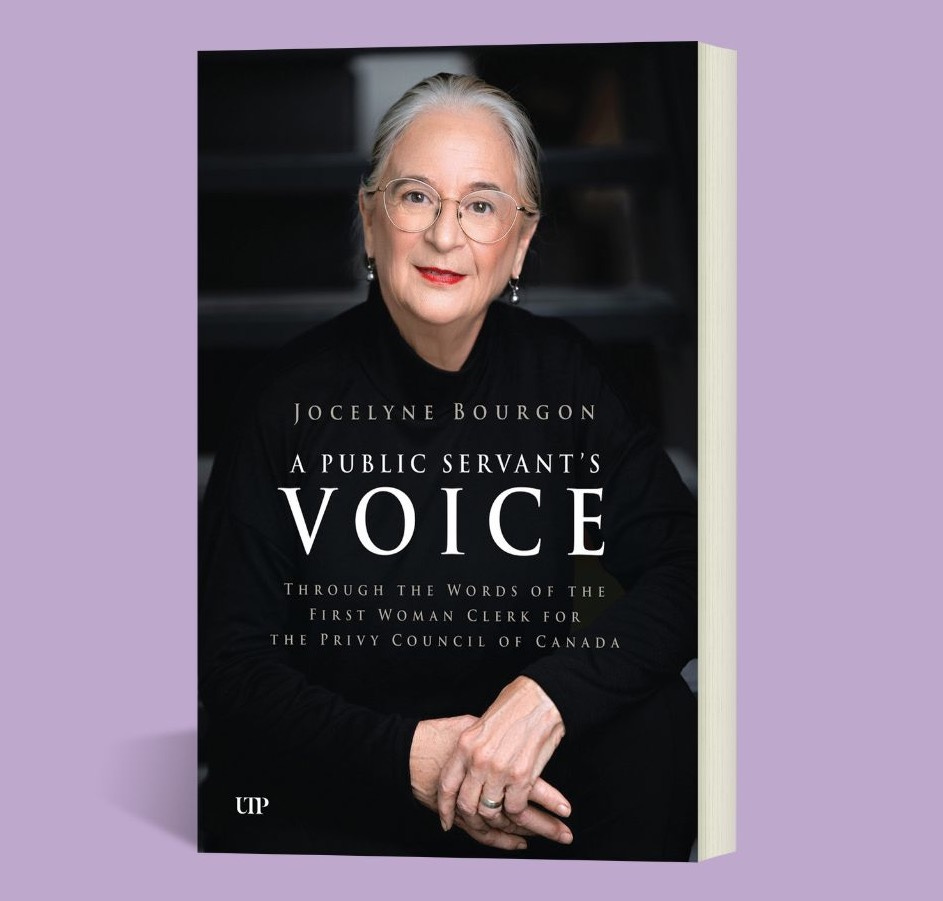
You may already have it but if you do not, you should pick up a copy of A Public Servant’s Voice by Jocelyne Bourgon. This is a truly exceptional new Canadian book, part memoir and part first-hand account of the challenges of our well respected federal public service.
I have been waiting for this book for thirty-four years. I started looking for a book like this in 1992. I was at the University of Toronto doing graduate work in leadership, learning theory and engagement practices. I was gathering and reading all sorts of books on these issues but I soon realized there was nothing on the shelf for the public servant story. They were all about private sector leaders and business based innovative practices. I read Senge, Peters, Drucker, Mintzberg, Welch, Frederick Taylor and Alvin Toffler, looking for at least one public sector story.
Actually, there was one.
I got to interview Toffler once and when I asked him about the lack of good writing on public service, he argued with me and went on and on boasting about how he changed the American military to be a winner after the epic failure in Vietnam.
His bragging didn’t really help me in my search and over the years I thought of him and the subsequent epic failures in Afghanistan, Iraq and the Gulf War, but I digress.
Over my forty-eight years in public service, I worked for a number of fine leaders. I saw some good organizational practices and I was always in a continuous learning and curiosity mode. I was also an amateur freelance writer and story collector and so I was always on the lookout for stories.
The Chapters bookshelves had some excellent public sector academic writing but were still shy of any fine public service memoir and stories.
So, when Madame Bourgon sent me this autographed book with a lovely note of thanks for a small contribution from me, I was over the moon.
It was indeed the book I had been waiting for.
Jocelyne’s leadership path covers the whole spectrum of public service and will speak to all civil servants regardless of where they might be situated in these times.
I won’t try to cover that whole journey but like many of us she started early in 1973 as a summer student in Transport. She became a manager with Fisheries in 1975, a Director General in 1983, then an Assistant Deputy Minister and then a Deputy Minister in 1989.
I started my public service career in 1969 and never did get to management so her taking only sixteen years to the very top, tells me this woman had all the tools and the heart of a leader.
Obviously, she was brilliant, strategic and tough and so her last promotion is really where the book shines a big light. The real pinnacle in our Canadian public service is that final upgrade to Clerk of the Privy Council and Secretary to the Cabinet.
There are no more rungs on the ladder.
Let me give a personal summary of what I most appreciated in her story. Here are some examples of her leadership, coupled with her quotes:
· We see her humility. In that moment when Prime Minister Chretien told her she was the one he wanted for the top job, her reply was, “he could do better.”
· We see her clarity on good behaviour. When many of the men dealing with the Charlottetown Accord were exhibiting some bad behaviour, she took them on and she explains, “I am not a shrinking violet.”
· On executives constantly being shuffled into different portfolios, including her: “I was furious and made it known.”
· On the constant reorganizations: “Reorganizations should be avoided whenever possible.”
· On cuts and good fiscal management: “The challenge was not to figure out what to cut, but what to preserve for the future.”
· On the stress between the public service staff and the increasing volume of political staff: “There are six to eight hundred politically exempt staff who daily generate programming demands on departments. Is this wise?” she asks.
· On the role of Ministers in our government: “Ministers have lost direct access to the Prime Minister.”
· On the core value of leadership at all levels: “It calls for distributive leadership where every public servant is individually and collectively responsible for acting within their sphere of influence to improve the public service.”
· On learning organization theory, practice and system thinking: “The learning needed was not limited to the individual level, the public service needs smart organizations able to think through complex issues in new ways and to work across sectors and across boundaries.”
· On the next generation of public servants: “People serving in the second quarter of the twenty first century are facing a convergence of existential threats of which climate change is only one. They will serve without the benefit of the protective shield of international conventions that contributed to an extended period of peace and global growth. A world of realpolitik governed by the rule of the jungle is very different from a world governed by rules.”
Yes, indeed.
This was a voice that brought real change to the federal government in her time and in my opinion, a voice that could inspire every civic organization struggling these days in a world not appreciating or understanding the role of an impartial, professional and accountable public service in our democracies.
Also, when they decided that the word Clerk did not fully capture the role, the Head of the Public Service title became her new challenge. She had to not only create better administration of the public sector, but also build a renewed organizational culture of citizen driven service and civid engagement, that would bring more effectiveness and pride.
I only got to hang out with her once.
It was in a bar, or probably a fancy lounge in Halifax after a conference. How I was invited into that special table group, I have no idea. It was a lively discussion and she was a conversational delight. In fact, I was welcomed enough, to such an extent, that I felt emboldened to make a pitch. The evening ended and I found myself sharing the walk to the hotel elevator with her. By this time in my own work, I was tired of how much cash we were spending at these conferences on keynote speakers who had just climbed a mountain or won a Grey Cup. I wanted to hear more public service stories from working public servants.
So, I pitched this to her, but I added some crazy. I suggested that in my work I had come to really believe that mistakes were more often great learning opportunities rather than occasions for risk management. So as the elevator doors opened, I proposed that we hold a federal conference, once a year and the only speakers and workshop presenters invited would be public servants who had really screwed something up that year.
The learning from those mistakes would be through the roof, I suggested, cautiously speaking through a single glass of wine.
She could have responded from her position of wisdom and authority with a kindly but knowledgeable smile, but instead she was very positive and made me feel like my voice was not a bad thing for her to finish the day on. That evening she and I were actually far ahead of the now worldwide movement that started some year’s later in Mexico City. I really believe this leader enjoyed and respected conversations with front line workers like myself.
As I finished this book after so many years in public service, I do wish I could have read it when I was in the middle of it all, but I am so grateful to see it out there now for those still in the trenches. She has a writerly voice that grabs one’s interest in how departments work, how central agencies work (or not) and how the public service deals with constitutional crises, sovereignty, cabinet intrigues and balancing budgets.
She introduced us to disruptors like the La Relève initiative, challenging how we see leadership, engagement and change. This book is a peek behind the curtain and I would encourage my public service readers to share her story with those working out there, keeping the heat on our Canadian democratic values and needing a little inspiration.
She was a strong woman’s voice in a time when primarily men still chaired the meetings. This book can serve as an inspiration to women, and to all public servants, who follow in her footsteps.
From a public servant to an other: thank you